08 Apr 2026 • 5m read
Brake Disc vs. Rotor: choose the right one

Although you might think you already know everything you need to know about motorcycles, there’s always something new to learn. One of the most common questions we hear at XLMoto is about brake disc vs. rotor—what’s the difference, and does it really matter? That’s understandable, especially since terminology for motorcycle components can vary depending on where you are in the world.
Like our article on motorcycle clutch advice and tips, this blog addresses the key difference between brake discs vs. rotors as well as the job they perform on a bike. Read on to discover:
The difference between a brake disc and a rotor
Different types of brake discs and rotors
Guidance on when a brake disc or a rotor might need to be replaced
How to choose a replacement brake disc or a rotor for your bike
FAQs about motorcycle brake discs and rotors

Understanding the Difference Between a Brake Disc and a Rotor
As mentioned, the question of what's different between a motorcycle brake disc vs. a rotor is one that comes up frequently. Sometimes, bike owners get confused when these key parts are referred to by mechanics and suppliers. However, it is relatively straightforward to clear up any potential mix-ups. That's because they both do the same essential job.
Essentially, these parts are the round metal components that are attached to a motorcycle's wheel. They provide a surface onto which the motorcycle's brake pads can clamp. When the brakes are deployed, the pads generate friction against these circular components, which then slows the motorbike down. You can learn more about motorcycle brake pads in our informative blog on the subject.
For now, all you need to know is that the disc—or rotor—on each wheel spins as you ride your motorcycle. These components are part of the disc braking system, which is the most common type of braking setup found on modern motorcycles.
Brake Disc vs. Rotor: Are They Actually Different?
Simply put, brake discs and motorcycle rotors are two different terms for the same component. When a rider applies a brake lever or pedal, the brake caliper squeezes the pads towards one another until they come into contact with the disc or rotor. As such, they convert kinetic energy into friction, thereby slowing and eventually stopping the motorcycle. Whether you prefer to use the term brake disc or rotor makes no difference to the way these components actually function.
Sometimes, OEM (original equipment manufacturer) suppliers will refer to one or other terms exclusively. There again, OEM component suppliers may also use both terms interchangeably when selling into different markets. Therefore, parts may be physically identical but sold under different names. What motorcyclists need to understand is that choosing a brake disc vs. rotor isn't an issue, just as long as the part they obtain is compatible with their bike. They are one and the same.
Brake Disc vs. Rotor: An Understandable Confusion
Given that purchasing a brake disc vs. a rotor for your bike means being able to choose either (no matter how they are marketed), you might wonder why there are two terms for the same part in the first place. This comes down to regional differences in the way English is used. In the UK, for example, the term brake disc is by far the most commonly used name for this particular component. This is the same in many other English-speaking parts of the world, such as Australia, New Zealand and parts of India, among others.
In the United States, the term rotor is by far the most commonly used word for this part of the braking system. It’s widely used across the American automotive industry, not just for motorcycle brakes. For off-road bikes in particular, rotor dominates, and it’s also the preferred term for most other types of motorcycles. You can think of this regional difference as similar to other familiar variations between American and British English, like gasoline vs. petrol or hood vs. bonnet.
In Canada, most motorcycle parts suppliers and mechanics also use rotor as the preferred term. However, this isn’t universal, especially when it comes to imported European bikes, where brake disc may still appear. With the rise of global online parts shopping, many experienced suppliers now use both terms to avoid confusion and ensure clarity for mechanics and motorcycle owners alike.

Types of Motorcycle Brake Rotors
Now that you understand the key difference between a brake disc vs. a rotor, it's worth getting to grips with the different types available on the market today. In fact, understanding the variety of discs or rotors is even more important than knowing the terminology. Why? Because each type of disc or rotor offers different performance characteristics. In principle, you can fit any of them on your bike, just as long as the specific disc or rotor you choose matches the requirements of your motorcycle’s braking system.
Whether they're marketed as brake discs or rotors, the main options offered by motorcycle manufacturers and OEM suppliers are outlined below.
Fixed Brake Discs
Fixed brake discs, also known as solid brake discs, are the most straightforward type of braking component. Whether labelled as rotors or brake discs, they consist of a single solid piece of metal that bolts directly onto the wheel hub. Thanks to their simple, durable, and cost-effective design, they’re commonly used on budget-friendly motorcycles and scooters. Typically made from stainless steel, fixed discs are also often found on the rear wheels of larger motorcycles, where less intense braking is required.
Advantages of Fixed Brake Discs
Durable rotor design built for reliable, everyday use
Lower cost compared to other types of motorcycle brake discs
Minimal maintenance with few components
Stable braking feel, especially at low speeds
Limitations to Consider
Less effective at dissipating heat energy than other types, especially under heavy braking
Can be prone to warping when exposed to extreme temperature fluctuations
Limited expansion capacity under thermal stress, which can affect performance over time
Heavier design versus alternative performance rotors


Floating Brake Rotors
Floating rotors, or floating brake discs, differ from fixed ones in that they are made up of two separate components: the outer braking surface, known as the disc ring, and the inner carrier, commonly referred to as the centre hub. These two parts are connected by rivets or bobbins, which allow the disc ring to expand and contract independently of the hub.
This two-piece design improves heat dissipation and reduces the risk of warping under extreme braking conditions. As a result, floating brake discs are typically found on high-performance motorcycles, especially on the front wheels, where braking demands are usually the greatest.
Advantages of Floating Brake Rotors
Excellent heat management, especially during prolonged or aggressive braking
Reduced risk of warping, which contributes to consistent long-term braking performance
Improved brake pad alignment for a more responsive, precise braking feel
Ideal for riders who engage in sport, racing, or adventure motorcycling
Limitations to Consider
May feel overly sensitive, especially on lightweight or lower-spec bikes
More expensive than fixed brake discs or rotors
More components may result in higher maintenance costs
Can rattle or generate other unwanted noise when not functioning properly
Sometimes slightly heavier than some petal rotors, depending on the exact configurations


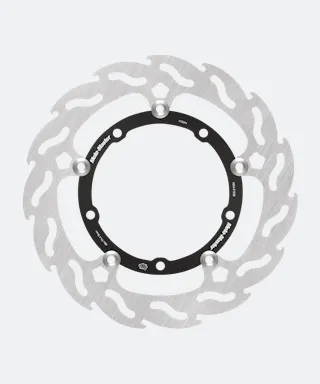
Wave or Petal Rotors
Motorcycle wave rotors, or wave brake discs, feature a scalloped edge that resembles a wave or flower petal, which is why they are also known as petal discs. While the design is visually striking, its benefits go beyond aesthetics. The wavy shape reduces the overall weight of the disc and helps to increase airflow, allowing for faster cooling during intense braking.
Some petal brake disc manufacturers also claim that the design will improve debris shedding, allowing for better contact between the brake pads and the rotor. For this reason, wave rotors are often used on trail bikes and motorcycles intended for off-road conditions. They’re also popular on dual-sport and street sport bikes, offering a balance of performance and distinctive visual appeal.
Advantages of Wave or Petal Rotors
Lighter than solid rotors and most standard floating rotors
Many offer better debris clearance, making them perfect for off-road and dirty conditions
Superior cooling due to their greater surface area per volume, with more exposure to airflow
Typically have an eye-catching design, which many bikers prefer for customised or sport bikes
Limitations to Consider
Generally the most expensive rotor type due to advanced manufacturing processes
Can lead to faster brake pad wear because of the uneven edge profile
Often unnecessary for casual riders or urban commuters
May have compatibility issues with certain caliper and pad shapes


When to Replace a Brake Disc vs. Rotor
Whether you call it a brake disc or a rotor, the criteria for when to replace one remains the same. The length of time a motorcycle rotor or brake disc will last comes down to how much the bike is used and how often—and how heavily—the brakes are applied. Typically, rotor manufacturers state that their products will last for at least 12,000 miles, but you can often expect them to last up to three times longer, depending on the road conditions you encounter and your riding style.
It’s essential to check the minimum thickness rating for any brake disc. Every motorcycle brake disc or rotor should be stamped with this measurement, indicating the lowest safe thickness before replacement is required. If either one of the rotors on your bike is worn below this limit, then it must be replaced immediately, even if it appears intact or seems to perform normally. Riding on a disc that’s too thin is a risk to your braking safety and could lead to brake failure.
Many motorcycle manufacturers recommend checking brake discs and rotors every 6,000 miles or so. This is a reasonable period within which wear could have occurred that would be sufficient to warrant a replacement. If you don't ride your motorbike that much, then opt for an annual inspection, even if you haven't reached the 6,000-mile limit. Although a professional inspection is advisable for casual riders, this is a job you can do yourself. Use a micrometre or vernier caliper to measure each brake disc. Remember, though, that one measurement per rotor will not be sufficient. Wear can be uneven on such brake components, so you should confirm the width at several points around the circumference of each rotor.
It is also worth noting that wear is likely to be uneven between the front and rear brake discs. Rotors on the front wheel tend to do a lot more work than their rear-mounted counterparts. Therefore, a check on the rear disc won't tell you whether or not the front one needs to be replaced. On the other hand, trail bikers or riders who need a lot of slow-speed control from their bike may find that the rear disc takes more of a beating. In other words, there is no hard-and-fast rule, and you need to check them both to be sure.
As well as the all-important remaining thickness of each of your motorcycle's rotors, you should also perform a straightforward visual inspection. Look at the brake discs side-on to detect whether or not there are any grooves or scoring on them. This can occur when debris becomes trapped between the brake pads and the rotors. If so, the performance of the brake disc concerned may be compromised. The same goes for thermal damage. Extreme temperature changes can result in cracks or heat spots, which means the discs don't offer as much control when braking. High-performance floating rotors are often more susceptible to this compared to fixed brake discs, so pay particular attention if you have a set.
Finally, a warped or misaligned rotor should be either refitted or replaced. One common sign of this issue is a pulsing sensation when the brake is applied. If the pads are making uneven contact with the disc due to warping, braking efficiency can be severely compromised, leading to longer stopping distances and reduced control. In most cases, the best course of action is to replace the faulty rotor entirely.

How to Choose the Right Brake Disc or Rotor for Your Motorcycle
If you’re looking to replace a brake disc on your motorcycle, a like-for-like replacement is often the simplest and safest option. You’ll already be familiar with how it performs, and even a new version of the same disc will likely outperform a worn one. That said, upgrading to a higher-quality rotor can be a wise move, especially if you want something better suited to your riding style. Here's what to bear in mind when choosing a replacement rotor or brake disc for your motorbike:
For riders who want a low-maintenance, reliable option without added complexity, standard fixed brake discs made from stainless steel are a solid choice.
Ride frequently in wet weather? Petal rotors help shed water more efficiently, which gives you better braking performance in the rain.
For riders in hot, dry climates, heat resistance might be a top priority, making floating brake discs a strong option.
If you ride through corrosive environments like smoggy city centres, consider rotors with anti-corrosion coatings or surface treatments.
Incorrect disc size can prevent proper fitment with your calipers or brake pads, so always check the compatibility.
Stainless steel is widely used, but cast iron rotors are also available. They provide strong braking but are heavier, more brittle, and prone to corrosion.
Floating rotors are ideal for touring bikes used in hilly areas, where you might apply brakes for long stretches when descending.
Track riders should look at carbon-ceramic rotors for their lightweight design and enhanced performance.
Mounting style matters, so make sure the rotor's bolt pattern and profile match your motorcycle's wheel hub.
Some motorcycles use twin-disc setups—in these cases, both rotors should be identical for balanced braking.
Finally, remember that the diameter of your replacement rotor must match the original. If it's too large or small, it may not fit or perform correctly.
Brake Disc vs. Rotor FAQs: What Riders Should Know
Should riders consider ABS compatibility when replacing their brake disc or rotor?
Yes, if your motorcycle has an anti-lock braking system (ABS), compatible brake rotors often need to include—or work with—an ABS tone ring. This is a slotted or toothed sensor ring that helps the system monitor wheel speed. When replacing your motorcycle brake disc or rotor, check that the tone ring is fully compatible with your motorcycle’s ABS sensor before buying.
Can I upgrade a brake disc to a different rotor type?
Yes—as long as the new rotor matches your motorcycle’s specifications, such as bolt pattern, diameter, and thickness of your current rotor, you can upgrade to a different rotor style. Riders often choose to upgrade to a different style for better heat dissipation or improved braking feel. For example, switching to a floating or wave rotor can enhance performance for those who enjoy spirited riding.
Do wave rotors perform better than standard round discs?
Petal rotors, also known as wave brake discs, typically offer improved heat dissipation, a lighter weight, and superior debris clearance. This makes them a good choice for off-road or high-performance biking. That being said, for everyday commuting or touring, a standard round disc often provides more than enough stopping power for the average rider.


